The partner's guide to her cycle: what's really going on, and what to do about it
Let me start with the thing nobody actually tells you. You can love someone completely and still spend years quietly baffled that the same person is warm and up for anything one week, and wants the whole world to leave her alone the next. You're not imagining it. You're also not doing anything wrong by noticing it.
Her body runs on a roughly monthly rhythm, and that rhythm shifts her energy, her mood, her patience, her sleep, sometimes her skin and her appetite and how much she wants you near her. None of it is random, even when it feels random. Once you can see the pattern, most of the guesswork falls away, and you get to stop reacting and start showing up.
This is the long version. If you want the short one, here it is: learn her cycle, match your effort to the week, and stop taking the low days personally. Everything below is just the detail that makes those three things actually work in real life, on a Tuesday, when you're tired too.
One thing before we go further, because it matters more than anything else in this article. This is not a manual for handling her, and it is definitely not a way to win arguments by blaming her hormones. If you ever catch yourself thinking "she's just being hormonal," put the phone down and have a word with yourself. The point is the exact opposite. It's to understand her better so you can be kinder, with better timing. Get that backwards and you'll do more damage than a man who never learned any of this.
Think seasons, not switches
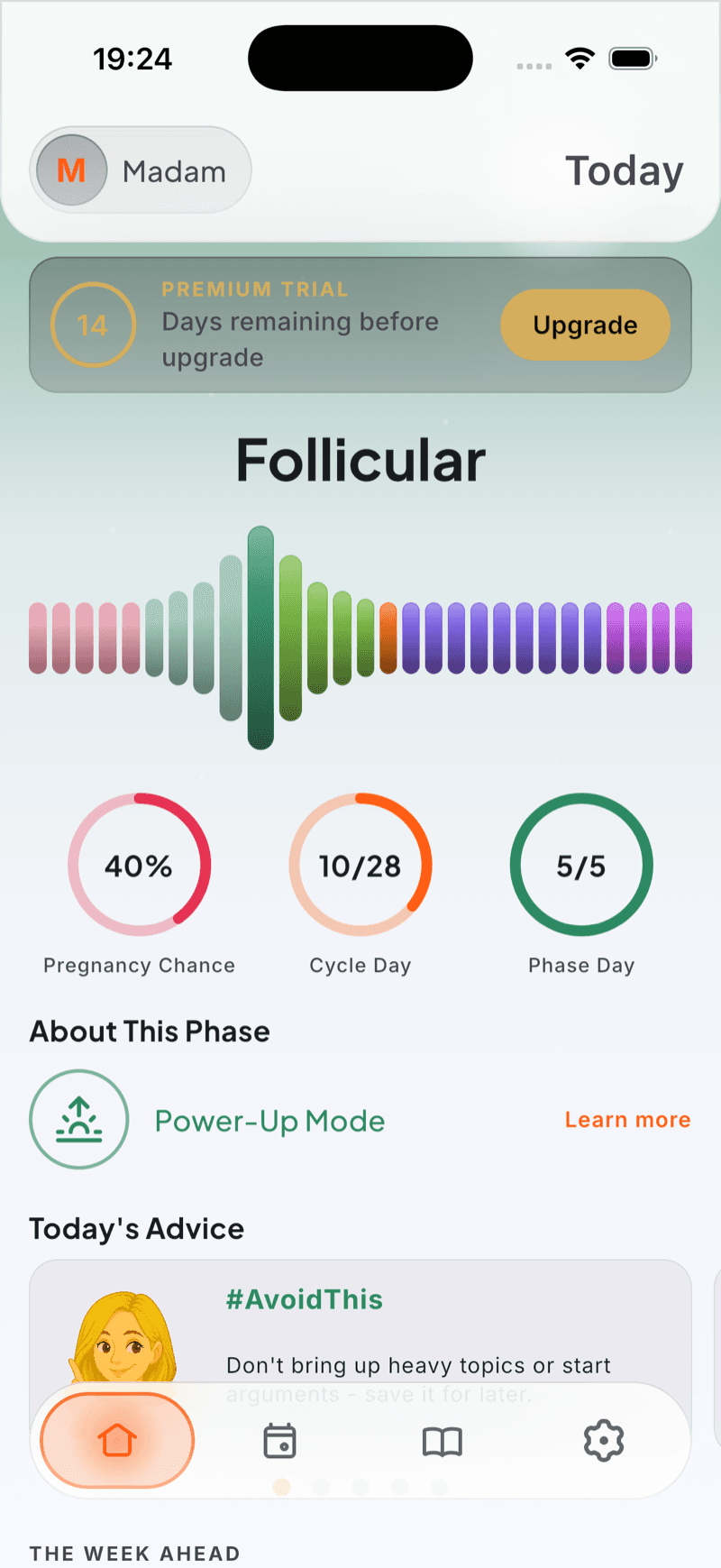
Here's the mental model that made all of this click for me. Her cycle is not a light switch flipping between "fine" and "not fine." It's a set of seasons. And like real seasons, they arrive gradually, they blur at the edges, and each one asks something different of you.
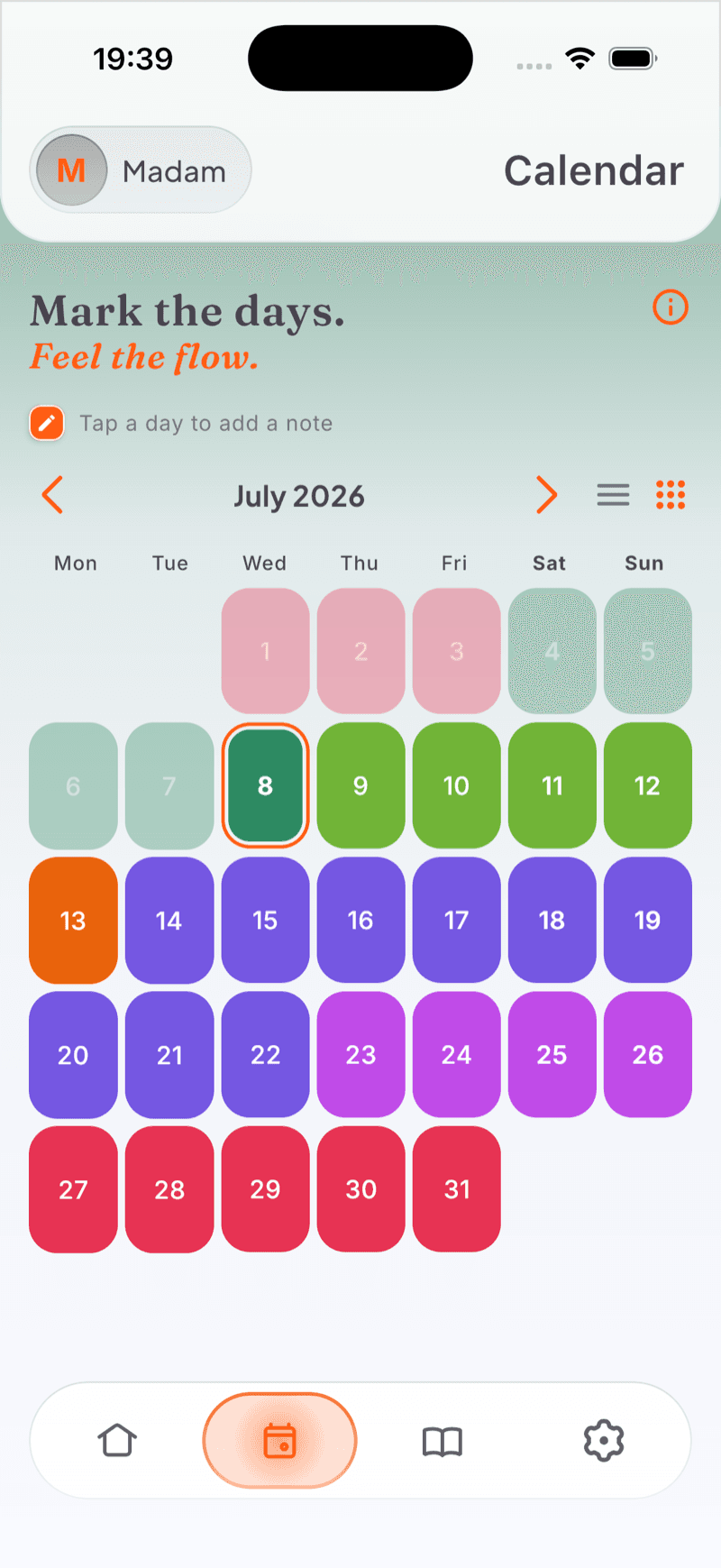
Roughly, a cycle runs about 28 days, though anywhere from 21 to 35 is completely normal, and plenty of people are irregular on top of that. Day one is the first day of her period. From there the body climbs through a bright, energetic stretch, peaks around ovulation near the middle, then winds down through a slower, more inward stretch until the next period starts and the whole loop begins again.
You don't need to memorise the biology. I'll give you just enough to make the advice make sense, and not a scrap more. What you actually need is the shape: up in the first half, down in the second, a peak in the middle, a dip at the end. If you remember nothing else from this whole article, remember the shape.
The reason the shape matters is timing. The same gesture, the same joke, the same "shall we go out Friday," lands completely differently depending on the season she's in. A good partner isn't the one who always says the right thing. It's the one who says it at the right time. The seasons tell you the time.
Setting it up without being weird about it
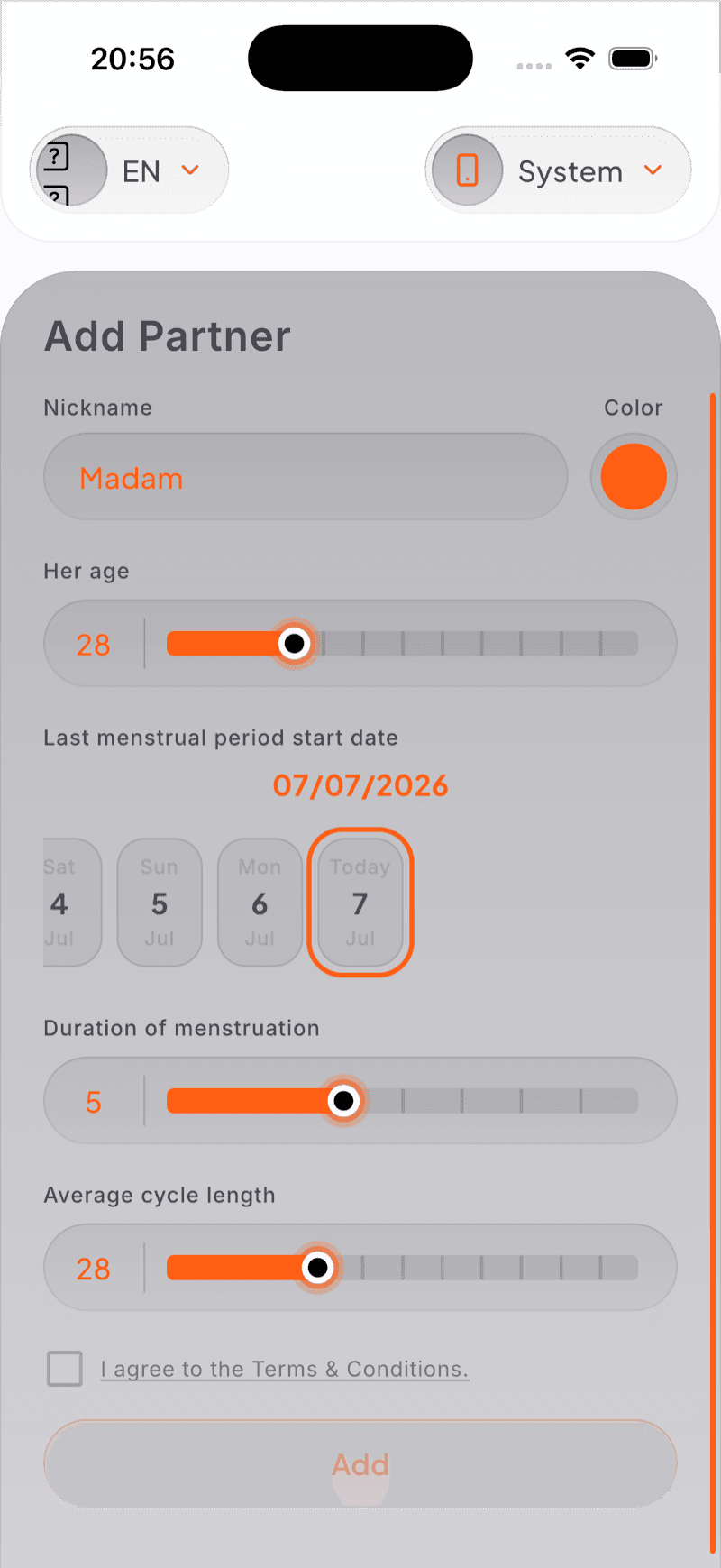
Quick practical bit. To get anything useful out of this, the app needs three things: when her last period started, roughly how long her cycle usually runs, and roughly how many days her period lasts. That's the whole setup. Thirty seconds, once.
If you already know that from living with her, good, put it in. If you don't, this is worth an actual conversation instead of detective work, and I'd push you toward the conversation every time. "I got this thing that helps me be less clueless about your cycle, can you tell me when your last period started so I set it up right?" is a good sentence. It's honest, it's a little self-deprecating, and it hands her control of her own information.
What you must not do is treat this like surveillance. Don't track her in secret. Don't use it to keep score. Don't announce "you're due for PMS in three days" with a smug little face on, like a weather warning. The whole thing works precisely because it makes you more thoughtful, and there is nothing thoughtful about making her feel watched. Her data sits on your phone, it exists so you can be better, and that's where it stops.
Once it's in, the app does the counting. Every morning it tells you where she is and what that usually means. You bring the part it can't: actually knowing her. The average cycle is a useful guide. Your specific person is the real thing, and she'll differ from the average in her own particular ways. Learn those over time.
Week one: the period itself
Day one is the first day of bleeding, and it's the reset. Hormones are at their floor. For a lot of people the first day or two is the physically hardest part of the whole month: cramps ranging from mildly annoying to genuinely floor you, low energy, a heavy dragging tiredness, sometimes a headache or a rough night's sleep. Some people barely notice any of it. Some are wiped out. You'll learn which one she is faster than any app can tell you.
What she often needs this week is simple and unglamorous. Warmth. Rest. Painkillers within reach. A hot water bottle. Her favourite food without having to ask for it. And permission to do nothing at all. This is not the week for a big social push or "let's shake up the routine" energy. It's the week to lower the bar for what counts as a good day, and to quietly carry more than your half.
The move that costs you nothing and buys a lot: anticipate. If you know the cramps usually hit, have the painkillers and the hot water bottle out before she asks. If you know day one wipes her, don't book your mates round for the football that night. Take the mental load off her. "I've sorted dinner, you don't have to think about it" is worth more than a bunch of flowers this week, and it's cheaper too.
What not to do: don't vanish, and don't hover. There's a real difference between giving her space and making her feel like she's been left alone to deal with it while you play it safe in the other room. Check in lightly. Bring the tea. Then let her be. And please, if she's curled up with cramps, this is not the moment to raise the thing that's been bugging you about the joint account.
One more, because it took me embarrassingly long to learn. Periods are not gross, and reacting like they are is a hurtful own goal. Buying tampons is not a big brave favour, it's just shopping. Be the guy who can be handed a list with pads on it and not make a face, and you're already ahead of a depressing number of men.
Week two: the comeback
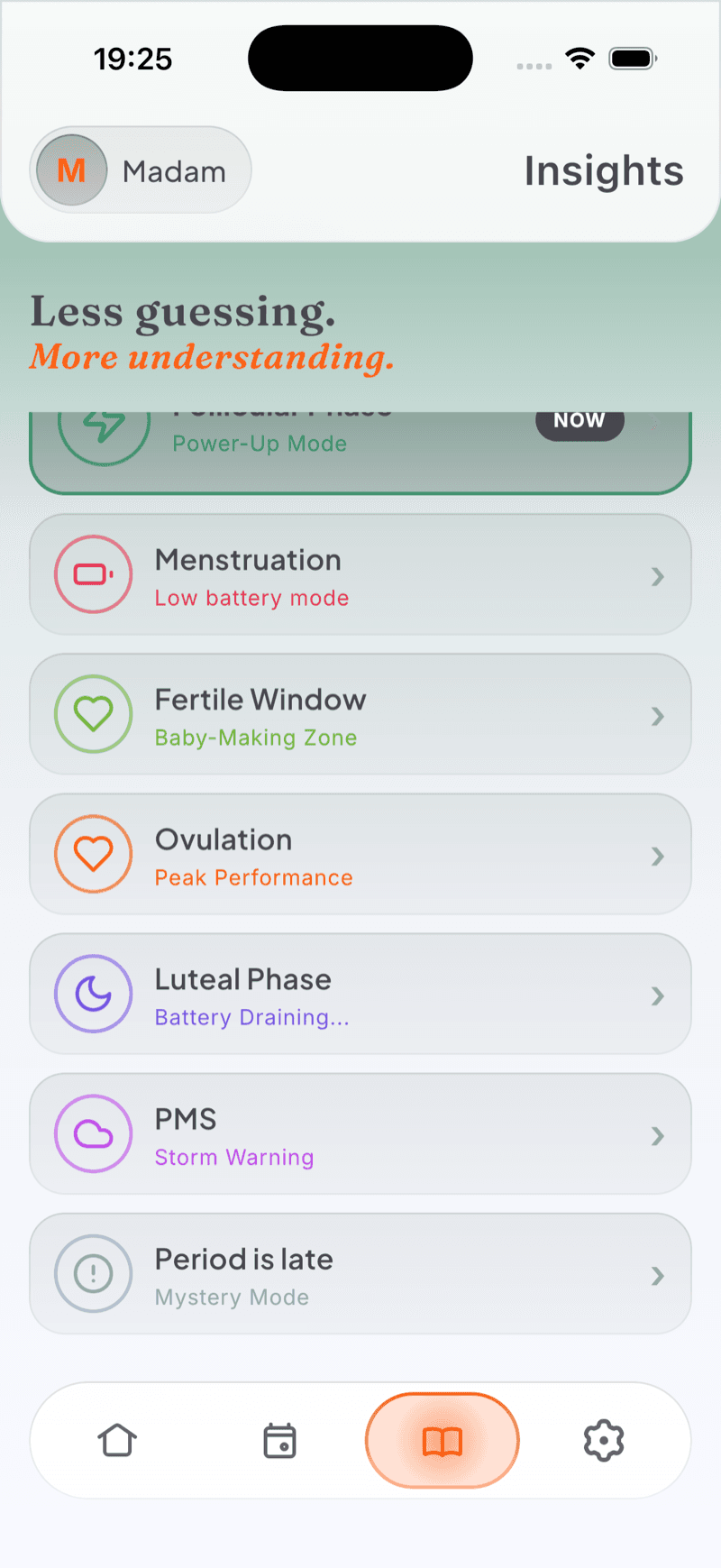
As the period tapers off, estrogen starts climbing, and this is where a lot of people feel genuinely good. Energy comes back. Mood lifts. She's more up for things, more social, more open to plans, often sharper and more focused at work. If the period week is winter, this is early spring, and you can feel the difference in the house.
This is your green light for the good stuff. The trip you've been meaning to book. The double date. The ambitious cooking project. The big idea you want to talk through. Openness and energy are usually higher here, so plans land and conversations flow. If there's something you've been sitting on because the timing never felt right, the back half of this week is often exactly the right time.
It's also a good stretch for the two of you to do something new. Novelty is more appealing when energy is high. That doesn't have to mean grand. A different walk, a restaurant you've never tried, tickets to something on a whim. The point is she's more likely to say yes and actually enjoy it, and shared new experiences are quietly some of the best glue a relationship has.
There isn't much to avoid here, honestly. The main mistake is not noticing. If every single week gets the same flat, low-effort version of you, you waste the good ones. Match her energy when it's up. Don't be the guy who wants to stay in every night and then wonders, months later, where all the fun went.
The fertile stretch: drive and confidence rising
In the few days before ovulation, estrogen keeps climbing toward its peak and testosterone gets a small bump too. In practice that often means rising libido, higher confidence, and a generally magnetic, up-for-it mood. She may feel more attractive, more flirtatious, more physically interested in you. Plenty of couples find this the easiest, warmest stretch of the whole month.
The obvious note here is about sex, so let me be straight about it. Interest is often higher in this window. Higher interest is not a green light on its own, and it never overrides a plain no. Read her, not a calendar. The app can tell you the odds are good. It cannot tell you she's in the mood tonight, and treating a phase as consent is exactly the creepy misuse we're trying to stay a mile away from. Flirt, be present, make it easy for her to want you, and let her lead at least as much as you do.
If you're actively trying to avoid or achieve a pregnancy, this is the window that matters biologically, and here I have to be blunt: this app is not birth control, and it is not a fertility treatment. It's a companion. For anything to do with actually preventing or planning a pregnancy, that's a conversation for the two of you and a doctor, with real methods. Do not bet a pregnancy on a mood forecast.
Away from the bedroom, this is a confident, outgoing stretch. A good time to be out together, to let her shine in company, to be the partner who's visibly proud of her rather than quietly competing with her. Small thing, big effect: hype her up in front of other people, and mean it. She'll feel it, and so will everyone in the room.
Ovulation: the peak
Around the middle of the cycle, an egg is released, and this is roughly the high point of the whole arc. Energy, mood, confidence and sociability often peak together for a day or two. Many people feel their most themselves right here: the most outgoing, the quickest, the warmest. It's usually brief. Enjoy it, and use it.
There's very little to manage here and a lot to make the most of. If you've been meaning to have people over, host this week. If there's a celebration or a big night out, this is when she's most likely to be firing on all cylinders and glad she went. Ride the wave. Say yes to the plans. You'll both remember the good ones long after the flat weeks blur together.
One quieter note. A fair few people get a sharp, one-sided twinge around ovulation, sometimes strong enough to notice, occasionally strong enough to worry about. It's common and usually harmless, but if she mentions a sudden pain mid-cycle, take it seriously and be kind rather than dismissive. Knowing roughly when ovulation lands means you can say "could be ovulation pain, but let's keep an eye on it" instead of offering a blank shrug.
The long wind-down
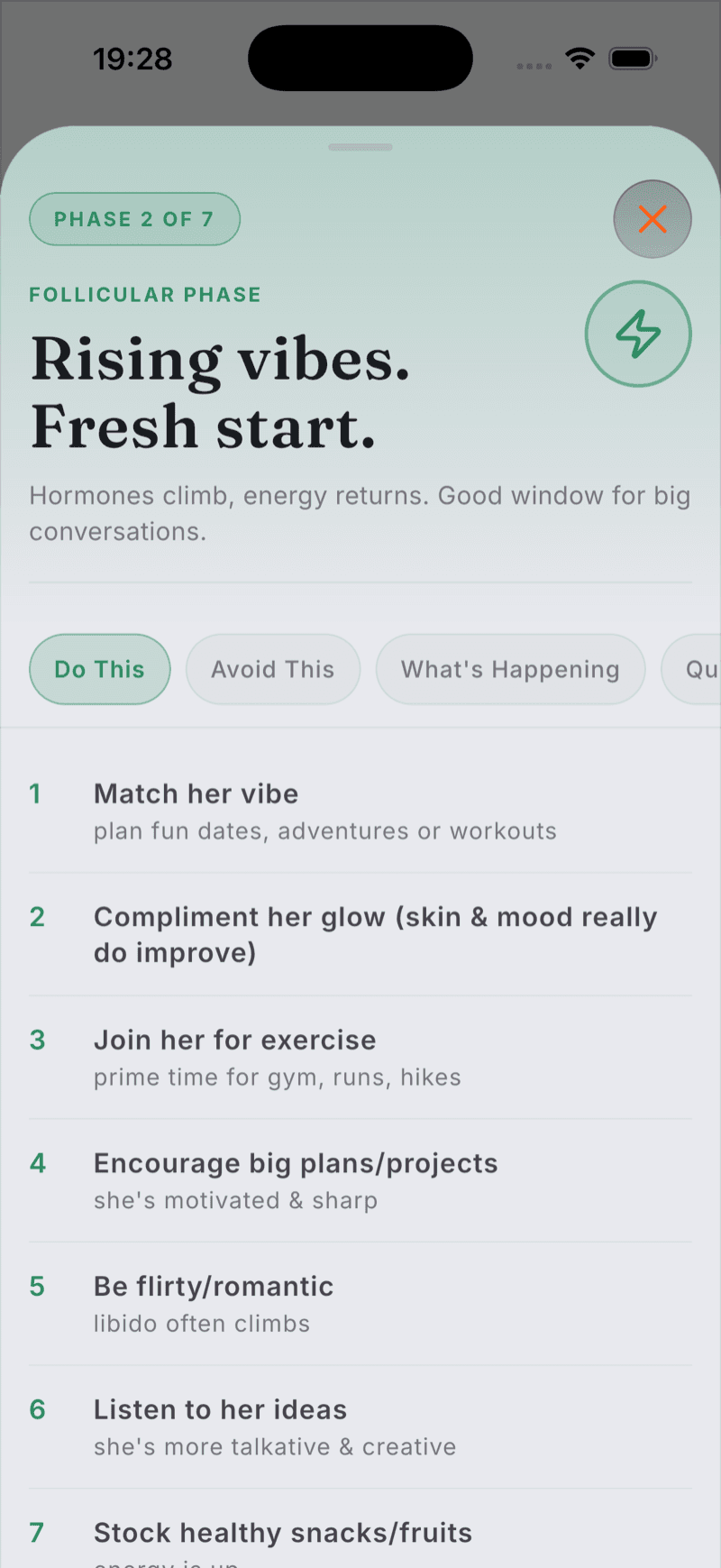
After ovulation, progesterone rises and estrogen dips, and the whole system starts turning inward. This is the long, slow back half of the month. Early on she may still feel fine, even cosy and a bit nesting-ish. But as the days pass, energy usually tapers, patience gets a little thinner, and the appetite for big social plans quietly fades. Winter is coming back, gently at first.
The main skill here is easing off the intensity without going cold. Fewer big asks. More low-key comfort. This is a good stretch for nights in that actually feel nice rather than like a consolation prize: a proper dinner at home, a series you're both into, an early night with no guilt attached. Nesting energy is real, and leaning into a warm, calm home instead of a packed calendar tends to land well.
It's also the stretch where the small, steady stuff matters most. Doing your share without being asked. Not creating extra friction. Noticing when she's flagging and taking something off her list before she has to spell it out. None of it is dramatic. All of it adds up, and it's the difference between her reaching the last week of the cycle already depleted, or reaching it with something still in the tank.
What to avoid: don't pick this stretch for the big confrontation or the major decision if you can possibly help it. Not because she can't handle it, but because it's more likely to go sideways when patience is already low. If it can wait for the next bright week, let it wait. If it genuinely can't, be extra gentle and extra clear, and don't spring it late at night.
The premenstrual week: the one everyone gets wrong
Let's talk about the week before her period properly, because it's the one that wrecks the most relationships and the one the culture treats as a punchline. In the days before bleeding starts, estrogen and progesterone both fall off a cliff. For people who are sensitive to that drop, it can mean irritability, low mood, anxiety, tearfulness, poor sleep, bloating, sore breasts, cravings, and a shorter fuse than usual. For a smaller number it's severe, and there's a real diagnosis, PMDD, that is far more than "a bit moody" and deserves proper medical support, not a boyfriend rolling his eyes.
Here's the reframe that changes everything. The feelings are real, even when the trigger looks small. If she's suddenly upset about something that normally wouldn't register, the mistake is arguing about whether it's a big deal. It feels like a big deal to her right now, and "you're overreacting" is possibly the four worst syllables you can produce this week. Her nervous system is genuinely running with less of the stuff that keeps everything level. Meet the feeling, not the logic.
So what actually helps. Steadiness, mostly. Be the calm, predictable, low-drama presence in the room. Take things off her plate without making it a performance. Feed her. Let her sleep. Absorb a bit of grumpiness without firing it back or keeping a tally. If she snaps at something daft, you do not have to win that exchange. Nine times out of ten it isn't really about the exchange, and letting it slide costs you nothing but a moment of ego.
The concrete moves: handle the logistics silently so there are fewer decisions for her to make. Have the comfort food and the painkillers ready before she asks. Suggest the low-key option, not the big night. Physical affection if she wants it, space if she doesn't, and ask rather than assume which it is. And genuinely, sincerely, do not start a hard conversation this week. Whatever it is, it will go better in about seven days, and it will still be true then.
What torpedoes this week: the eye-roll. The "is it that time of the month" line. Keeping a mental file of everything she said while she was struggling, to throw back at her later. Going cold and punishing. Or matching her irritation with your own and turning a rough patch into a full-blown fight. Make no move that says "you're a problem I'm putting up with." Every move should say "I've got you, and I'm not going anywhere."
And look, none of this means you become a doormat who absorbs anything. If something is genuinely unfair, it's fair to say so, kindly, later, once the week has passed. Understanding the week is not the same as having no needs of your own. It just means picking your moment and leading with warmth. You can do both. Most of the men who think they can't just haven't tried the timing part.
When the period's late
Sometimes the next period simply doesn't show up on schedule. Cycles vary, and stress, travel, illness and a dozen other things can push things back. A late period is common and usually nothing. But it can also be a tense, loaded stretch, especially if a pregnancy would be a big deal either way, and the tension is often heavier for her than she lets on.
Your job here is calm and present, not panicked and not dismissive. "I'm sure it's fine" can land as brushing her off. "Whatever's going on, we'll deal with it together" lands better, because it's about her not being alone in it. Don't interrogate. Don't make it about your own anxiety and hand her that to manage on top of her own. If a test is on the cards, offer to be there, offer to go and get it, and follow her lead on how much she wants to talk about it.
Knowing roughly when the period was due at least means you're not blindsided, and you can be the steady one in the room. The app shows the days ticking past the expected date. Use that to be gently ahead of it, never to pile on pressure.
When the textbook doesn't apply
Everything above describes a fairly average cycle, and I want to be honest that plenty of cycles are not average. Some people are naturally irregular, so the dates drift and the app's estimate is a rough guide rather than a timetable. If she's on hormonal birth control, the pill or an implant or a hormonal coil, the natural rise and fall is largely flattened or replaced, so a lot of the phase-by-phase stuff won't apply the same way. Conditions like PCOS or endometriosis change the picture too, sometimes a great deal.
None of that breaks the core idea. It just means you lean harder on watching the actual person in front of you, and less on the calendar. The app gives you a starting estimate. Her real pattern, and what she tells you about it, always wins. If the prediction and reality keep disagreeing, believe reality, and gently update what you've put in.
And a plain reminder, because it bears repeating: estimates are estimates. A phase forecast is a helpful nudge, not a medical fact and not a promise. For anything that actually matters clinically, pain that's severe or new, periods that vanish or go haywire, anything to do with a possible pregnancy, the answer is a doctor. Not an app, and not a blog written by a bloke who just wanted to be a better boyfriend.
A month, roughly, day by day
It helps to see it strung together, so here's a rough month, the kind the app is modelling under the hood. Treat it as a sketch, not a strict schedule, and remember her real numbers may run shorter or longer.
Days one to five, the period. Low and tender, especially the first two days. You're on tea, hot water bottle, and quietly taking things off her plate. You keep the week gentle and you don't take short answers to heart.
Days six to eleven, the comeback. Energy climbing, mood lifting, more up for things. This is when you book the trip, suggest the plan, have the good conversation you've been saving. Match her energy instead of coasting on autopilot.
Days twelve to fifteen, the peak. Confident, outgoing, often warmest with you. Say yes to plans, be out together, hype her up in company. If interest is higher, read her in the moment and let her lead, never the calendar.
Days sixteen to twenty-two, the wind-down. Still fine at first, then gradually more inward. You ease off the intensity, lean into cosy nights in, and quietly carry a bigger share of the invisible load without being asked.
Days twenty-three to twenty-eight, the storm-warning stretch. Shorter fuse, lower mood, more sensitive to everything. You go steady and calm, handle the logistics silently, absorb a bit of grumpiness, and you save every hard conversation for after the next period starts.
Then day one comes round again and the whole thing resets. Do this for two or three months and you'll stop needing to check the app so often, because you'll have started to feel the shape of it yourself. That's the real goal. The app is training wheels for paying attention.
The skills that matter in every phase

Phases are the map. But a handful of habits matter no matter what week it is, and honestly they're most of the game.
First, timing. Save the heavy conversations for the brighter, steadier stretches, and let the low weeks be low. This isn't manipulation, it's manners. You already do this instinctively with everyone else in your life. You don't ask your boss for a raise thirty seconds before a bad meeting. Same courtesy here, higher stakes.
Second, carry the mental load, not just the tasks. Doing the washing up when asked is fine. Noticing the bin is full and just dealing with it is better. The invisible work of running a life, the remembering and planning and anticipating, is exhausting, and it usually falls unfairly on her. Taking real chunks of it off her, especially in the low weeks, is one of the most genuinely romantic things you can do, and nobody ever puts it on a card.
Third, listen to understand before you listen to fix. A lot of us hear a problem and immediately start solving. Sometimes she does want solutions. Often she wants to be heard first, and the fix can come later, if at all. "That sounds really hard, I'm sorry" before "have you tried" will save you a hundred arguments you didn't know you were about to start.
Fourth, keep affection unhooked from sex. If the only time you're warm and touchy is when you're angling for more, she'll clock it, and it cheapens the warmth. Be affectionate in the low weeks when nothing at all is on the table. It makes the good weeks better, and it quietly tells her the closeness is about her, not just about what you want from her.
Fifth, small and well-timed beats big and generic every single time. The takeaway ordered on a rough night. The chore silently done. The text that says you were thinking about her. The thing she mentioned once that you actually remembered and acted on. That stuff outperforms expensive gestures on the wrong day, because it proves attention, and attention is the whole thing underneath everything else.
The mistakes almost everyone makes
Let me save you a few of the ones I made, in no particular order.
Blaming the cycle for everything. Not every bad mood is hormonal, and treating her like a set of predictable outputs is dehumanising and just plain wrong. Sometimes she's upset because you were genuinely annoying. The cycle is context, not a full explanation of her, and it is definitely not a way to dodge accountability for your own behaviour.
Going quiet to "keep the peace." Withdrawing in the hard weeks reads as abandonment, not diplomacy. Stay present. Presence with a bit less intensity is the goal, not disappearing into your phone until the storm passes.
Making her manage your feelings about her feelings. If she's having a rough week and your response is to get wounded and sulky, so that now she has to comfort you too, you've made the whole thing worse. Absorb more than you offload, especially in the low weeks. That's the job.
Keeping score. "But last week you said..." is a losing move every time. You're not a lawyer building a case against her. Let the small stuff go, and be genuinely surprised how much of it turns out to be small.
Treating the app as a substitute for knowing her. It's a starting point, an average, a nudge in roughly the right direction. Your actual person is more specific than any average, and the only way to learn her is to pay attention over time and to ask. The tech gets you into the right ballpark. You still have to watch the actual game she's playing.
What this is, and what it isn't
To be completely clear, because it's the easiest thing in the world to get twisted. This is a tool for empathy with better timing. It is not a way to manage, handle, predict-and-control, or blame her. It is not medical advice, it is not contraception, and it is not a fertility plan. And it is absolutely not a licence to explain her own feelings back to her. When in doubt: ask her, believe her, and lead with kindness.
It's worth saying plainly that her cycle is deeply private information, which is why this stays on your phone with no account and no cloud copy. That's not a footnote. Treating the data with the same respect you'd want for your own is part of doing this right. If the whole thing ever starts feeling like tracking rather than caring, stop and reset, because you've drifted off the point.
Used properly, though, this is genuinely one of the simplest upgrades you can make to a relationship. You stop being surprised. You stop taking the low days personally. You start turning up with the right thing at the right time, week after week, and she feels, correctly, that you get her. That's the entire promise, and it's a big one hiding inside a small habit.
You don't have to be a mind reader. You just have to stop guessing, and start paying attention with a bit of a head start.
So start with one cycle. Set it up, watch a single month go by, and just notice how much less of it catches you off guard. You won't get every week right, and you really don't have to. The bar was never perfection. The bar is being the partner who's clearly trying to understand, instead of the one waiting to be told what he did wrong this time.
One month. That's the whole ask. Do it consistently and you'll be amazed how much softer everything gets, for both of you.